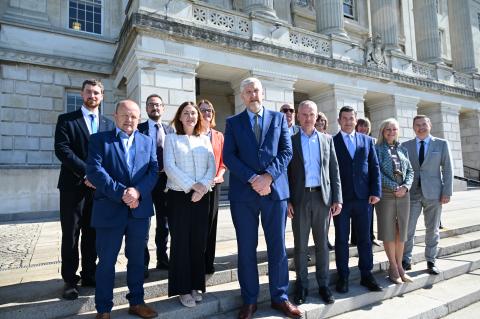
In December, the Department of Finance commissioned Ulster University Economic Policy Centre to conduct a sectoral cost of doing business study.
Minister John O'Dowd said: “There are many factors that make up the cost of doing business including the cost of labour, energy, property and transport.
“However one of the main areas for concern highlighted by employers in both the public and private sector has been the impact of the changes in Employers’ National Insurance Contributions which came into effect last month.
“The publication of the report, by the Ulster University Economic Policy Centre, is timely as it reaffirms decisions in Westminster are having a detrimental impact on our business, community and voluntary sectors as well as impacting on our public finances."
The Cost of Doing Business report considers the potential impacts of the changes in Employer’s National Insurance Contributions, the increases in the National Living Wage, and other challenges facing employers across a wide range of sectors using hypothetical firms of different employee sizes, earnings, and full-time and part-time worker compositions.
The report highlights how the unexpected nature of the NICs announcement has made it difficult for many organisations to manage and the reduction in the earnings threshold at which NICs becomes payable, will have a greater proportional impact on employers of lower paid and part-time staff. As NI has the lowest average earnings in the UK, it will therefore be the most impacted of all UK regions
The Voluntary and Community Sector is one of the most impacted sectors, others include: Hospitality; Agriculture; Retail; Arts & Entertainment. For example a larger social care employer with a mix of 100 f/t and p/t staff could see costs rise by £67k p.a. (NICs impact only) and including earnings rises, labour costs could increase by £180k p.a.. The occupations most impacted: Retail staff, cleaners, adult and child-care workers, hospitality workers, delivery drivers, security guards.
The report also highlights other cost issues
- Insurance
- Raising input costs
- Rental costs
- Rates
- High energy costs
Impact on Voluntary and Community Sector
NLW and NICs increase will have disproportionate impact on the sector
- The sector tends to employ higher numbers of staff on wages at or near the NLW, therefore amongst the most impacted.
- Critical component in the public service delivery infrastructure but will not receive an uplift in funding (unlike the public sector).
- Narrow margin organisations with limited reserves and no pricing power (Government sets the price on public services).
- Very limited scope for further efficiencies after several years of significant funding constraints.
- 76% of respondents state that the increases will have a major impact on their organisation. (NICVA Survey)
Likely to lead to reduced services
- Reduced services through a combination of reduced hours, possible redundancies, recruitment freezes and pay freezes for other staff, with the increased risk of losing key staff.
- Impacts the sector’s commitment to becoming a Real Living Wage sector and funding for staff professional development. Differentials also need to be maintained to incentivise recruitment into and retention of staff into supervisor roles.
- Typical services impacted: community focused programmes, respite care, subsidised services such as childcare and transport.
- Concerns over quality of service delivery being maintained, closure of subsidised services, longer waiting times, fewer programmes, increase in fees.
- This reduced service capacity will impact the most vulnerable when demand is increasing.
- This in turn could result in a redirection to the statutory sector, further increasing pressure and higher associated costs.
- Increased risk of organisations ‘walking away’ from contracts and/ or not bidding for new contracts.
Calls for additional funding to be provided
- Public sector contract values should be uplifted to meet the additional NICs costs (est. cost £20m p.a.).
- Small grant scheme should be put in place for V&C organisations not involved in public service contracts (est. cost £12m p.a.).
- Without this additional funding, then increased costs will be incurred elsewhere including the statutory sector.
Other issues raised in the consultations:
- Prior to NICs and NLW increases, the sector faced significant workforce challenges (NICVA Workforce Survey Sept 2024):
- 42% faced difficulties retaining staff (48% reported high levels of staff burn-out as a contributing factor)
- 49% faced difficulties recruiting staff (76% identified salaries as an issue and 56% saw short-term contracts as an issue)
- There is a need to bring consistency to contract management across health trusts with delivery partners to maximise efficiency.
- Significant vacancies in the sector due to recruitment and retention challenges, caused by low pay and insecure employment (staff are regularly put on protected notice because funding renewal decisions are taken very late). This creates an expensive reliance on agency staff.
- Insurance costs rising in general, but sector specific issue around insurance linked to safeguarding children and vulnerable adults. In addition, organisations providing transport services to the vulnerable are experiencing significant increases in insurance costs.
- Loss of service could have a wider impact on the families of service users e.g. need for parents/ carers to give up work.
- Longer term concerns about succession planning at a leadership level in the sector, given the very challenging nature of the sector and the unfavourable pay & conditions environment relative to the public and private sectors